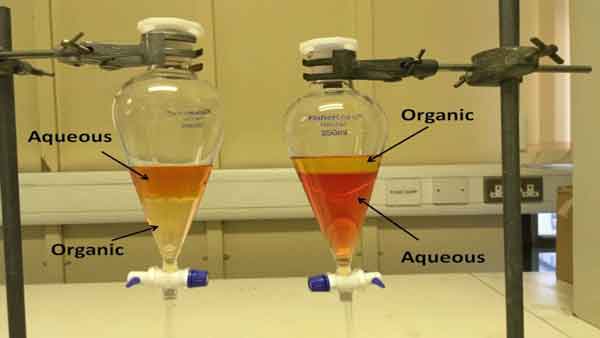
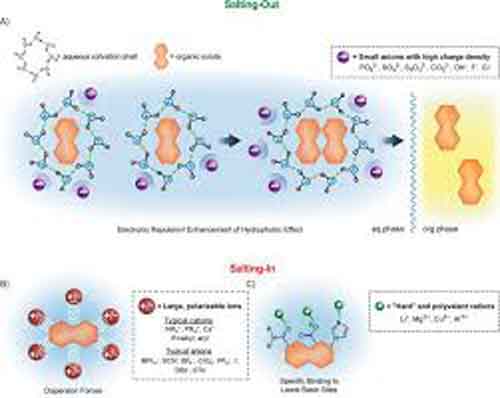
Liquid- liquid extraction is based on relative solubilities of a mixture of compounds in two immiscible liquids, usually a polar solvent like water and an organic (non-polar) solvent.
This separation/partitioning occurs on the basis of the Nernst distribution law whose equation is given by: k = Corg /Caq
Where, k= distribution coefficient,
Corg = Concentration of analyte in the organic phase,
Caq = Concentration of analyte in the aqueous phase
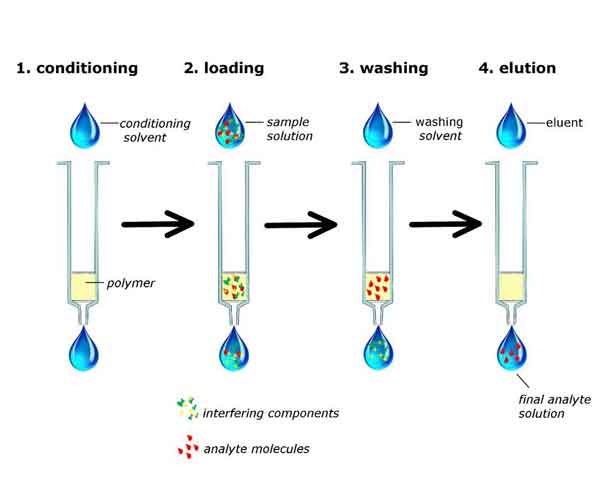
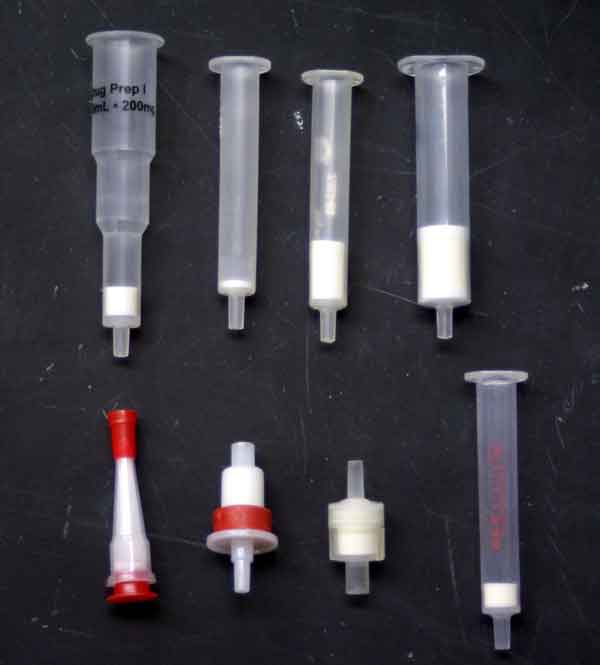
Solid phase extraction is a sample preparation process in which analyses in a liquid mixture are separated according to their physical and chemical properties.
Principle:
SPE makes use of the affinity of the analyses dissolved in a liquid for a solid through which the sample is passed to separate into desired and undesired components.
Steps:
Conditioning:
Activation of the solid/stationary phase using a polar solvent, usually water or methanol
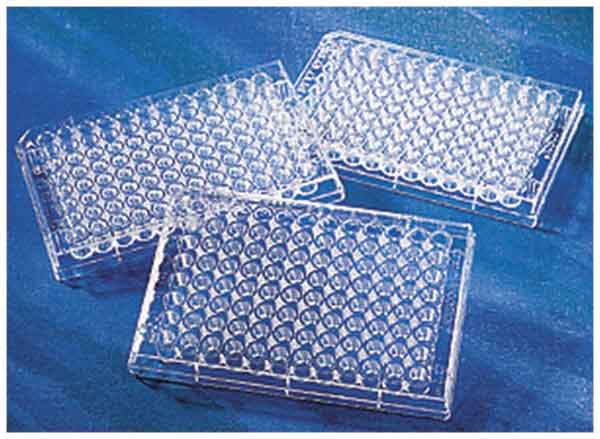
Protein precipitation is widely used to concentrate proteins and to purify them from various components.
The most common method by which protein precipitation is done is by salting out.
In this method, a neutral salt such as ammonium sulphate is added so that the protein-protein interaction increases.
As the concentration of the salt keeps on increasing, the proteins interact with the salt instead of water and so the organic patches on the protein are exposed, causing the protein to clump and precipitate.