
sancharFirst Logo
  • Pharmacokinetics/Pharmacodynamics
  • Definitions
      Pharmacokinetics
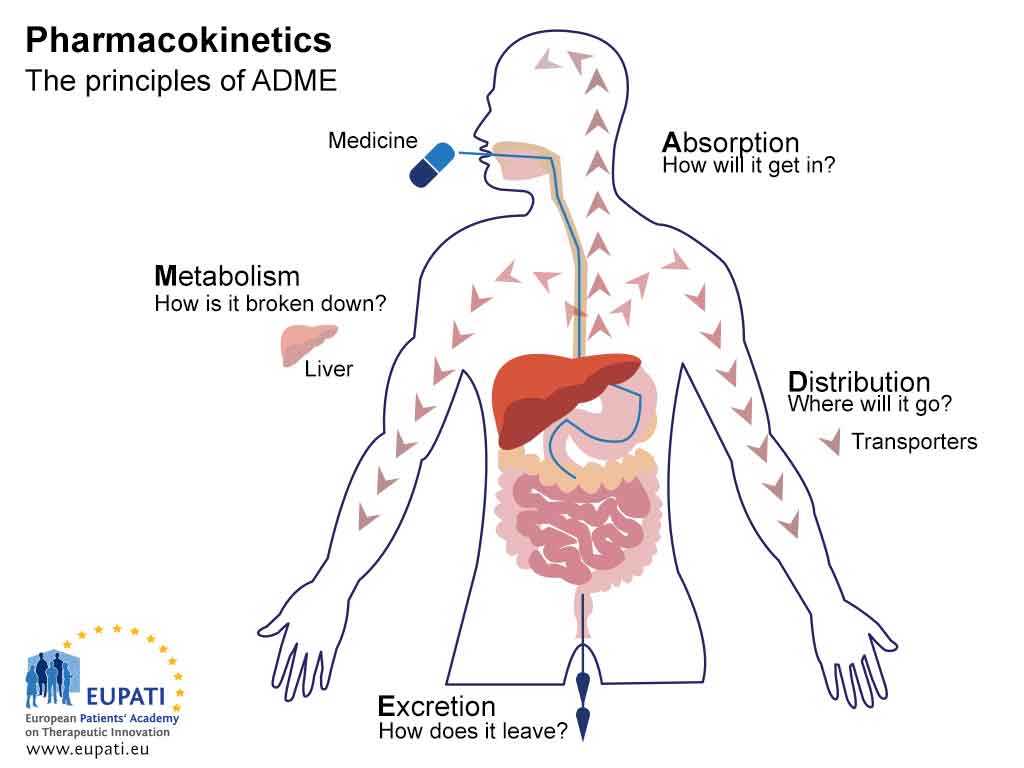
    • Pharmacokinetics is the study of the bodily ADME (Absorption, Distribution, Metabolism and Excretion) of drugs OR Pharmacokinetics is the study of characteristic interactions of the drug and the body in terms of its ADME.


    • Pharmacodynamics
    • Pharmacodynamics is a branch of pharmacology (study of drugs) which deals with the interaction between drugs and living systems.
    • Basically, in layman terms, pharmacokinetics is the study of what the body does to a drug and pharmacodynamics is the study of what the drug does to the body.
  • Pharmacokinetic curve and the pharmacokinetic parameters
      Principle
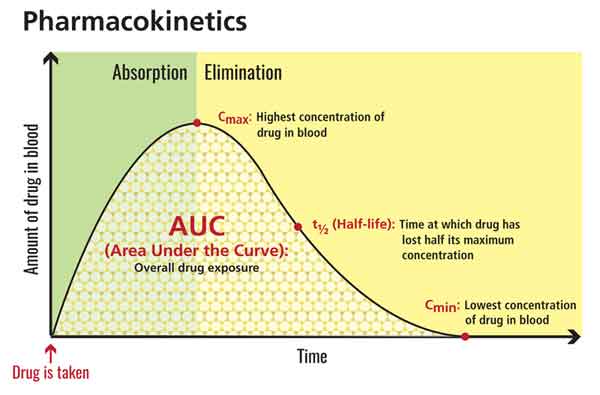
    • In order to describe what the body does to the drug when it is taken, the concentration of the drug is noted at various fixed time intervals and a graph is plotted which is known as the pharmacokinetic curve.
    • For giving information about the drug from this curve, various parameters are set which are known as pharmacokinetic parameters.


    • Some of them are:-
    • Absorption rate constant (ka)
    • It is the fractional rate of drug absorption from the site of administration into the blood.
    • It decides the time required for the drug to reach a concentration in the plasma at which it is most effective and thus affects the onset of the drug effect.
    • This time taken for the drug influences both the peak concentration of the drug in plasma as well as the time taken by the drug to reach its peak concentration.

    • Half Life (t1/2):
    • It is the time taken for the concentration of the drug in the plasma to be reduced by 50%.
    • It is dependent on the drug’s clearance and its volume of distribution.
    • The half-life of a drug decides the length of its effect.
    • It also decides whether there will be any accumulation of a drug if multiple dosage regimen is followed.
      • Elimination rate constant (λ):
      • It is the fractional rate of drug removal from the body.
      • It is independent of the concentration of the drug in the body.

      • Volume of Distribution (Vd):
      • It is the volume of the fluid that would be needed to contain the amount of drug present in the body at the same concentration as in the plasma.
      • The volume of distribution of a drug gives information on its distribution in the body.
      • For instance, a drug that accumulates in the tissues will have a low concentration in the plasma and therefore the Vd will be high.
      • Thus, it is important in estimating the dose required to achieve a particular plasma concentration.

      • Clearance:
      • It is the ratio of the rate of drug elimination to the plasma concentration, the result being a volume of plasma from which the drug is completely eliminated per unit of time.
      • It reflects the elimination of a drug from the body which is generally due to liver metabolism and/or excretion by the kidney.

      • Area under the curve (AUC):
      • It is defined as the integral/addition of all the parts of the plasma drug concentration time curve/pharmacokinetic curve.
      • It reflects the actual concentration of drug the body was exposed to after administration of this dose.
  • ADME (Absorption, Distribution, Metabolism, Excretion) and the factors affecting it
    A) Absorption:
    • The first process of pharmacokinetics is absorption.
    • It is a term which refers to the movement of a drug into the bloodstream from the site of administration.

    • Factors affecting absorption of drugs:

    a) Drug related factors:

    • Lipid water solubility coefficient:
    • It is the ratio of dissolution of drug in lipid as compared to water.
    • The greater the lipid water solubility coefficient, higher is the absorption.

    • Molecular Size
    • Smaller the molecular size of the drug, more rapid is the absorption.

    • Particle Size
    • Larger the particle size, slower will be the absorption and vice versa

    • Degree of Ionization
    • If drug in unionized state, better diffusion so better absorption

    • Physical Forms
    • Gases rapidly absorbed than liquids, liquids rapidly absorbed than solids.

    • Chemical Nature

    • Salt forms of drugs better absorbed than organic compounds when administered orally.
    • Drugs in inorganic forms are better absorbed than in organic forms.

    • Dosage forms
    • Affect rate and extent of absorption.

    • Formulation
    • Other substances in the formulation if not inert can affect the absorption.

    • Concentration
    • Higher the concentration, more the flux and therefore extent of absorption is affected.

    • b) Body related factors
    • Area of absorptive surface
    • Larger the surface area, better the absorption and vice versa.
    • Vascularity/Blood supply
    • More the vascularity, greater the rate and extent of absorption. 

    • pH
    • Acidic pH favours absorption of acidic drugs and basic pH for basic drugs.

    • Presence of other substances
    • Foods/drugs may interact with the drugs to alter rate of absorption especially oral drugs.

    • GI Mobility
    • Increase or decrease in GI mobility affects the extent of absorption.

    • Functional integrity of absorptive surface
    • Flattening and swelling of mucosa decreases absorption.

    • Diseases
    • Diarrhoea- Decreases absorption-Decreased contact time
    • Malabsorption- Decreases absorption
    • Emphysema- Affects the absorption of volatile gases through the lungs
    • Lipodystrophy- Decreases absorption and the effect of insulin in diabetic patients is lost

    • B) Distribution:
    • The second process of pharmacokinetics is distribution.
    • It is the process in which there is reversible movement of drug from one location to another within the body.
    • There are various factors that affect distribution of drugs in the body viz.

    • a) Factors related to the drug:
      Lipid solubility
    • Greater the solubility of the drug in lipids, higher is the distribution and vice versa.

    • Molecular mass
    • Higher the molecular mass, less is the distribution.

    • Degree of ionization
    • Depending on the pH of the medium, drugs are ‘trapped’ when they are in the ionized form which affects distribution.

    • Cellular binding
    • Duration of Action- Free form more easily released than bound form

    • b) Factors related to the body:
      Vascularity
    • First drugs go to highly profused areas and then redistributed to less profused areas.

    • Transport Mechanism
    • Different drugs taken up by different compartments of the body differently.

    • Blood Barriers
    • Selective passage or even efflux/exit

    • Placental drugs
    • Efflux barriers- exit/efflux of drugs from foetus to mother

    • Plasma binding proteins
    • Drugs bind to such proteins and hence affect distribution

    • Free and Bound forms of drugs
    • They affect distribution as free forms of drugs are excreted rapidly while bound forms act as drug reservoirs.

    • Drug Interactions
    • If number of drugs simultaneously given or if the volume of distribution is too high or too low, it affects the distribution

    • Disease States
    • Different diseases affect the distribution of drugs.

    • Drug Reservoirs
    • In these, the drugs are stored and released slowly which affects their distribution.

    • Metabolism/Biotransformation:
    • The second last process in pharmacokinetics is metabolism.
    • It is the process of conversion of a drug within the body in order to make it more water soluble so that is eliminated from the kidneys easily.
    • Metabolism is a very important process in pharmacokinetics because if the drug remains water insoluble then it cannot be excreted and thus accumulates leading to toxic effects.
    • There are many factors which affect metabolism viz.

      Enzyme Induction:
    • When drugs are taken for a long time, increase in synthesis of enzymes takes place.
    • In this process, most of the times, cytochrome P450 is involved.

    • As this enzyme synthesis takes place, the rate of metabolism increases.
    • When drugs are taken together, drugs acting as enzyme inducers of others can sometimes lead to an increase in their own metabolism. This process is known as auto-metabolism.
      Enzyme Inhibition:

    • After certain drugs are taken, the metabolizing capacity of cytochromes is reduced.
    • This process is known as enzyme inhibition and leads to a decrease in metabolism.

    • First Pass Effect/Route of Administration:
    • Most of the drugs are metabolized in the liver in a process known as first pass metabolism.
    • Hence, changing the route of administration might change the first pass metabolism.

      For e.g. Propranolol, an anti-hypertensive drug, is 80% metabolized before reaching the blood vessels.

      Genetic Variations:
    • Inter-individual variations can occur due to the fact that drugs behave differently in different individuals because of genetic variations.
    • For example, some people have a deficiency of pseudocholine esterase, an enzyme which metabolizes succinyl choline, a skeletal muscle relaxant. This causes lack of metabolism of succinyl choline.


    • Different groups of population can be classified as fast metabolizers or poor/slow metabolizers.
    • For example, for isoniazid, an anti-TB drug, fast acetylators as well as slow acetylators exist. Fast acetylators acetylate isoniazid rapidly while poor metabolizers metabolize less.


      Species Difference:
    • Some species metabolize drugs more rapidly than others.
    • For example, rats and rabbits metabolize drugs more efficiently than humans.
    • Even within different races of people, there is variation in the metabolism.
    • For example, Eskimos metabolize drugs more efficiently than Asians.

    • f) Exposure to Pollutants from environment or industry:
    • Cigarette smoking or chronic alcoholism can cause enzyme induction.
    • Similarly, pesticides or insecticides can also cause enzyme induction.

    • If the climate is hot and humid, metabolism is decreased and vice versa.
    • At high altitudes, metabolism is reduced due to less amounts of oxygen.


      g) Age:

    • In humans, the drug metabolizing capacity develops early but is low.
    • Thus, infants have a low rate of metabolism.

    • Hence, care must be taken in giving drugs to younger patients.
    • Similarly, in the geriatric population, most of the body processes slow down which leads to a decrease in metabolism.

    • In older population, the organs start to shrink along with decreased liver functions and reduced blood flow to the liver because of which there is a decrease in metabolism.
    • Older people take multiple drugs, so they are more prone to toxicity. Therefore, the doses should be reduced in the older people.


      h)Sex:
    • The basal metabolic rate (BMR) in males is higher than that of females. Thus, males can metabolize drugs more efficiently.
    • During pregnancy however the rate of metabolism in females is increased.

      i) Drug-Drug Interactions-
    • When drug combinations act as enzyme inducers and inhibitors which can result in toxic effects.
      j) Nutrition:
    • Malnutrition can affect metabolism of drugs.
    • Depletion of amino acids like glycine may also affect the drug metabolizing capacity, especially during phase II metabolism (conjugation/production of more polar molecules)


      k) Disease states:
    • Most of the drugs are metabolized in the liver, hence, any disease of the liver like cirrhosis, jaundice, hepatitis, etc. can affect and slow down the metabolizing capacity of the liver.
    • In case of cardiovascular diseases, the blood flow is reduced which can affect the metabolism of drugs like morphine, propranolol and isoniazid.
    • Similarly, hydrolysis of procaine and procainamide is impaired in case of pulmonary diseases.
    • Hypothyroidism decreases drug metabolizing capacity while hyperthyroidism increases it.


      l) Circadian Rhythm/Sleep Cycle:
    • The rate of metabolism in the liver follows diurnal rhythm in rats and mice which may be true for humans as well.

    • D) Excretion/Elimination:
    • The last process in the pharmacokinetics of drugs is excretion/ elimination.
    • It is any one of a number of processes by which a drug is eliminated from the body, either in the form of an unbound molecule or a metabolite.
    • The main organ by which excretion takes place is the kidney although it also takes place from other organs such as skin, liver, sweat glands, tear ducts, lungs, etc.
    • These organs or structures which are used to expel a drug from the body are known as elimination pathways.
    • Some of them are- urine, tears, sweat, saliva, faeces, bile.

    • Many factors affect the process of renal excretion. They are:
    • Drugs which are bound to large proteins in the plasma can’t be filtered out of the plasma and hence remain in circulation.
    • The drugs which remain unionised and the metabolites of drugs usually diffuse out of the renal tubule and are reabsorbed into the blood.
    • The pH of urine can change reabsorption and excretion because of the fact that it has an effect on the ionization of weak acids and bases.
    • Metabolic inhibitors can change the active tubular secretion of many of the drugs, especially when the concentration of the drug is high.

  • Go to the top of the page

    Go to Main Menu